Who Applies to Teacher Education Programs?
Much of what we know about teachers focuses on the workforce itself: where teachers work, how effective they are, and whether they remain in the profession. But understanding the teacher pipeline requires looking earlier. Who decides to become a teacher in the first place?
To answer that question, CALDER partnered with researchers, the state of Washington, and university-based teacher education programs to study the early teacher pipeline. Among other questions, the project examined which students apply to teacher education programs and what those decisions reveal about the future teacher workforce.
The following chart shows the cumulative share of students who applied to a teacher education program during their first four years of college. Students are grouped based on whether or not they indicated an interest in teaching when they first applied to college.
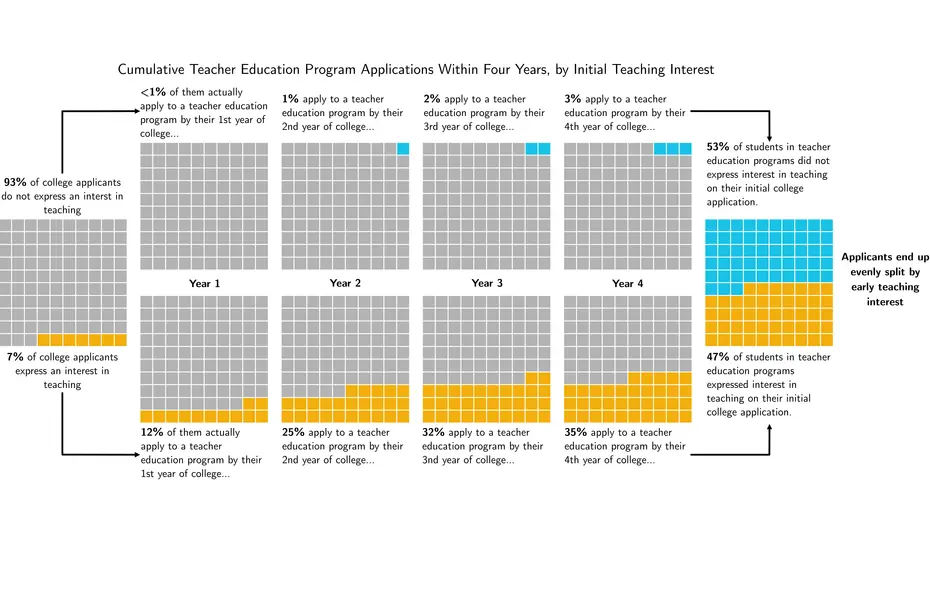
The results highlight the fact that interest in teaching changes over time. Across the three universities in the study, just 7% of incoming college applicants expressed an interest in teaching. But only about one-third of those students eventually applied to a teacher education program. By the time students reached the application stage, teacher education applicants were almost evenly divided between students who had expressed an early interest in teaching and those who had not.
College can be an important place to grow the teacher pipeline. If half of future teachers appear to discover an interest in teaching after they arrive on campus, what else could universities do to encourage talented college students to consider becoming a teacher?
Go deeper: Dan Goldhaber, Roddy Theobald, Amy Roth McDuffie, David Slavit, Jennifer M. Dechaine, John M. Krieg, Vivien Chen, Emma Dewil (2025). The Beginning of the Teacher Pipeline: Which College Students Apply to Teacher Education Programs?. CALDER Working Paper No. 328-0925. https://doi.org/10.63302/FDFX2366